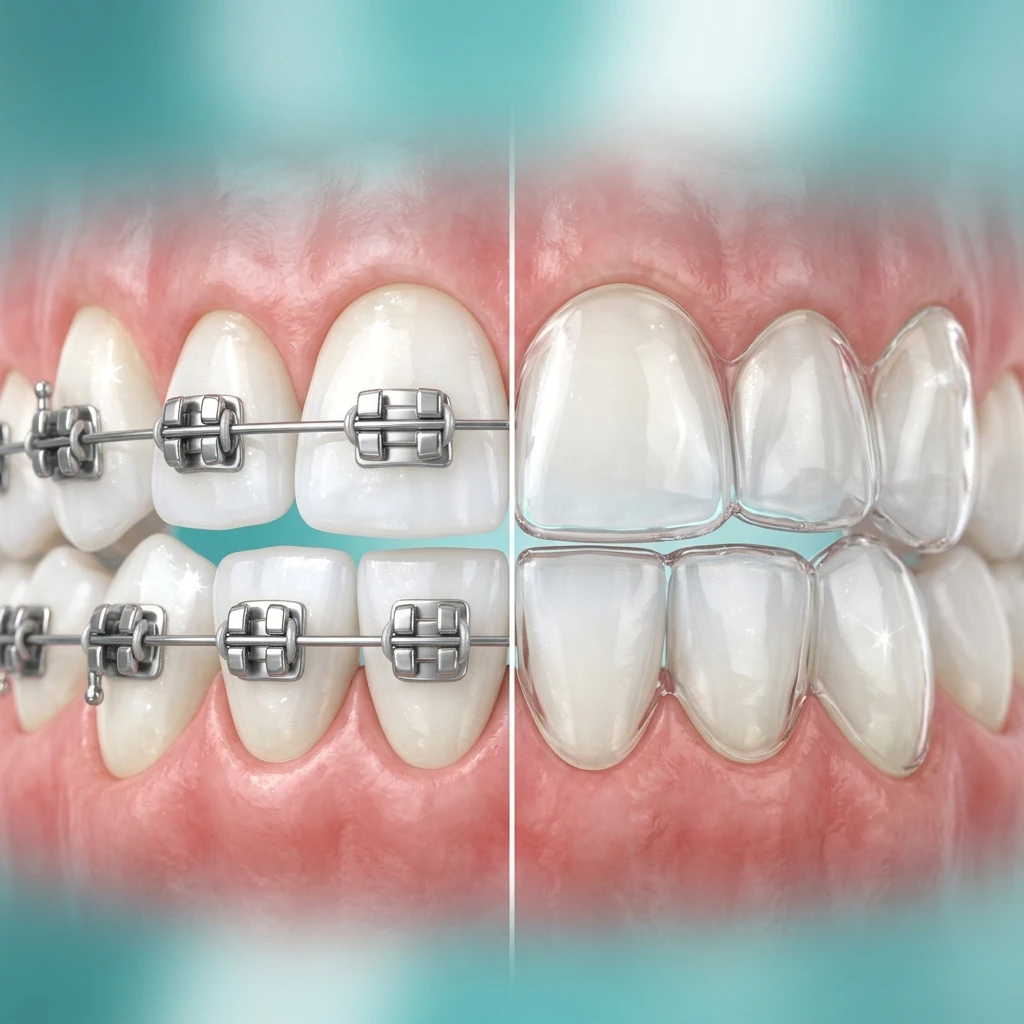
The Most Common Question in Our Clinic
"Doctor, should I get Invisalign or braces?" — it's a question we hear every single week. Both options straighten teeth effectively, but they work differently, suit different types of cases, and come with different lifestyle implications. This guide gives you the honest, unbiased picture so you can have an informed conversation with your orthodontist.
The truth is: there is no universally "better" option. The right choice depends on your case complexity, your discipline, your profession, your budget, and how you prioritise different factors. Let's break it all down.
How Each System Moves Teeth
Metal braces use brackets bonded to each tooth, connected by an archwire that's periodically tightened. The wire applies continuous pressure, guiding teeth into position. By adjusting the wire's tension, shape, and the addition of elastic bands, orthodontists can move teeth in all three dimensions with a high degree of precision. This continuous force application is particularly powerful for complex rotations and vertical movements.
Clear aligners work through a series of precisely manufactured trays that fit snugly over your teeth. Each tray is slightly different from the last, and the pressure difference between your current tooth position and the tray's designed shape is what moves the teeth. Small tooth-coloured "attachments" bonded to certain teeth give the trays additional grip for more complex movements. The force is intermittent — you change trays typically every 1–2 weeks.
Side-by-Side Comparison
| Category | Invisalign / Clear Aligners | Metal Braces |
|---|---|---|
| Appearance | Nearly invisible plastic trays | Visible metal brackets and wire |
| Removable? | Yes — remove for eating & brushing | No — fixed for entire treatment |
| Diet restrictions | None (remove before eating) | Avoid hard/sticky foods throughout |
| Oral hygiene | Easy — brush & floss normally | Harder — special floss threaders needed |
| Comfort | Smooth plastic, no sharp edges | Brackets can cause cheek irritation |
| Complex cases | Good for mild–moderate cases | Better for severe/complex cases |
| Patient discipline required | High (must wear 20–22 hrs/day) | Low (fixed — no choice) |
| Treatment duration | 12–18 months (most adults) | 18–24 months (most adults) |
| Clinic visits | Every 6–8 weeks | Every 4–6 weeks |
| Suitability for teenagers | Good if disciplined | Excellent — no compliance needed |
| Cost | Slightly higher on average | Generally slightly lower |
Where Braces Win
Traditional braces have a clear advantage when it comes to complex orthodontic cases. If you have a significant overbite, underbite, crossbite, or open bite combined with severe crowding, braces give your orthodontist the finest level of control. They can apply precise forces in multiple directions simultaneously — something aligners can approximate but not always match.
Braces also win on compliance. Because they're fixed to your teeth, there's no risk of not wearing them. For patients (particularly teenagers) who might be tempted to leave aligners out, braces remove the option and ensure treatment progresses as planned.
For significant vertical movements — such as extruding teeth that sit too low in the arch — braces are generally more effective. Aligner mechanics for these movements are improving but aren't yet as reliable.
Cost is another area where braces often have a modest edge, particularly for longer and more complex treatment plans.
Where Invisalign Wins
Aesthetics are Invisalign's signature advantage. Working professionals, adults in client-facing roles, or anyone who is self-conscious about the look of metal brackets will appreciate the near-invisible appearance of clear trays. This is often the single most important factor for adult patients.
Comfort and lifestyle are significantly better with aligners. You can remove them for a wedding, a presentation, a sport, or any important event. You can eat whatever you want. You brush and floss exactly as you did before treatment with no special tools needed. These quality-of-life factors are real and meaningful over a 12–18 month treatment period.
Oral hygiene outcomes are generally better with clear aligners. Braces create dozens of brackets and wire sections that trap food and make cleaning difficult. This contributes to decalcification (white spot lesions) and increased cavity risk. With aligners, you remove them and brush normally — hygiene is maintained easily.
Shorter clinic visits are another practical advantage. Because you change trays at home, appointments are mainly for monitoring rather than active adjustments. Visits are typically less frequent and shorter.
Our honest recommendation
For mild to moderate crowding or spacing in a motivated adult or older teenager: Invisalign is an excellent choice that delivers great results with superior lifestyle comfort. For complex bite corrections, younger teenagers, or patients who know they'll struggle with compliance: braces are the more reliable path. Book a consultation — we'll examine your case and tell you exactly which is better for you, without bias.
What About Ceramic Braces and Lingual Braces?
Ceramic braces use tooth-coloured brackets instead of metal ones, making them far less visible while retaining most of the mechanical advantages of traditional braces. They're a good middle ground for patients who need the precision of braces but want something more discreet. The main drawbacks are that ceramic brackets are slightly larger, can stain if you drink a lot of coffee or turmeric drinks, and are somewhat more expensive than metal.
Lingual braces are attached to the back (tongue side) of the teeth, making them completely invisible from the front. They offer the full power of braces with zero visible hardware. However, they're more expensive, require more adjustment time, can affect speech initially, and not all orthodontists offer them. They're a specialist option for patients who need complex correction but absolutely cannot have visible brackets.
Making the Decision: Questions to Ask Yourself
Before your consultation, consider: How important is discretion to you? Are you disciplined enough to wear trays for 20–22 hours daily? Do you have a complex bite problem or mostly cosmetic crowding? What is your budget? How long are you willing to be in treatment?
The most important step is getting an honest clinical assessment. At Krishna Dental, we use digital scanning to map your teeth precisely and give you a clear recommendation based on your actual anatomy — not based on which option has higher margins or is trendier. You can read more about our full orthodontics and braces treatment options in Gudivada before your visit.