Missing Teeth: Why the Replacement You Choose Matters
Losing one or more teeth affects far more than aesthetics. It changes how you eat, how you speak, and how your remaining teeth and jawbone behave. Without a tooth root, the jawbone beneath that gap begins to resorb — shrinking and losing density over time. This affects not just the gap but the structure of your face. The good news: modern dentistry offers excellent replacement options. Choosing the right one requires understanding the differences clearly.
There are three main approaches: dental implants, fixed dental bridges, and dentures (removable). Each has valid applications, and the best choice depends on your specific situation, health status, and priorities.
Dental Implants: The Closest Thing to a Natural Tooth
A dental implant consists of a titanium post placed surgically into the jawbone, an abutment, and a crown. The implant fuses with your bone through a process called osseointegration, creating a stable, permanent anchor. The crown attached on top looks and functions exactly like a natural tooth.
Key advantages: Implants preserve jawbone — the titanium post stimulates bone just like a natural root, preventing the resorption that occurs with bridges and dentures. They don't affect adjacent teeth. They're permanent and don't need to be removed. With proper care, a dental implant can last a lifetime. The crown may need replacement after 15–20 years, but the implant itself often outlasts everything else.
Limitations: Implants require surgery and a healing period of 3–6 months. They need adequate bone density (bone grafting may be required if bone has already been lost). They're the most expensive option upfront. Not suitable for uncontrolled diabetics, heavy smokers, or those with certain systemic conditions without medical clearance.
Dental Bridges: Fixed, No Surgery Required
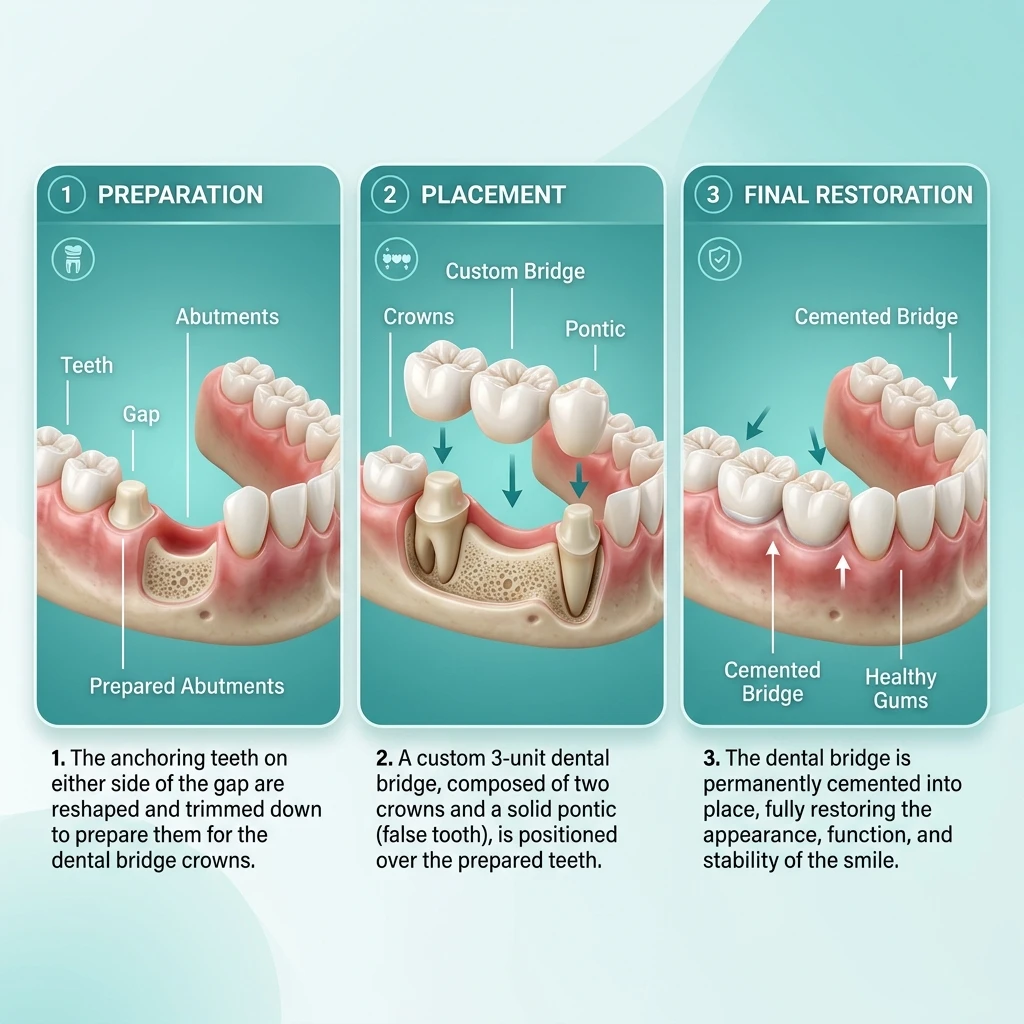
A dental bridge literally "bridges" a gap using two crowns on the adjacent teeth (called abutments) with one or more artificial teeth (pontics) suspended between them. The whole structure is cemented permanently — you can't remove it.
Key advantages: No surgery needed. Completed in 2–3 appointments over 2–3 weeks. More affordable than implants. Fixed in place — no removal or adhesives. Works well when the adjacent teeth already need crowns.
Significant disadvantage: Placing a bridge requires permanently grinding down the adjacent healthy teeth to accommodate crowns. This is irreversible. Additionally, bridges don't stimulate the jawbone underneath, so bone loss still occurs over time in the gap. Cleaning under a bridge requires special flossing tools.
Dentures: Removable, Affordable, Improving
Dentures are removable prosthetic devices that replace missing teeth. Full dentures replace an entire arch of teeth; partial dentures replace multiple missing teeth while the remaining natural teeth provide support.
Key advantages: Lowest upfront cost. No surgery required. Can replace many teeth at once. Modern dentures, especially implant-supported dentures, are far better than older generations — more comfortable, more natural-looking.
Limitations: Traditional removable dentures can slip, click, and feel unstable — particularly lower dentures. They require adhesives for a secure fit. They don't stimulate bone, leading to continued jawbone shrinkage over years, which changes facial structure and makes the dentures fit worse over time. They require daily removal and cleaning.
Head-to-Head Comparison
| Feature | Implant | Bridge | Dentures |
|---|---|---|---|
| Bone preservation | ✅ Yes — stimulates bone | ❌ No bone stimulation | ❌ No bone stimulation |
| Adjacent teeth affected | ✅ Not at all | ❌ Must be ground down | Partial dentures clip onto them |
| Removable | No — permanent | No — permanent | Yes — removed daily |
| Surgery required | Yes | No | No |
| Upfront cost | Highest | Moderate | Lowest |
| Lifespan | Lifetime (crown 15–20 yrs) | 10–15 years | 5–10 years |
| Feel & function | Most natural | Very good | Takes adjustment |
| Maintenance | Brush like normal tooth | Special flossing needed | Daily removal, cleaning |
Which Option Is Right for You?
For a single missing tooth in a healthy patient: a dental implant is almost always the best long-term choice if budget permits. It preserves the adjacent teeth and the jawbone, and typically lasts longer than a bridge.
For multiple missing teeth in a row: an implant-supported bridge (implants at each end with crowns in between) offers the best outcome. A traditional bridge is a reasonable alternative when budget is a primary concern.
For patients missing most or all teeth: implant-supported overdentures (All-on-4 or All-on-6) represent the gold standard — they combine the stability of implants with the efficiency of a full arch restoration. Traditional full dentures remain a valid option when implants are medically or financially unfeasible.
For patients with medical contraindications to surgery: bridges and dentures are appropriate alternatives. The right choice depends on how many teeth are missing and the condition of the remaining teeth.