Why Understanding Implant Types Matters
The term "dental implant" is used loosely — but implants are not one-size-fits-all. Different clinical situations call for different implant types, surgical approaches, and restoration designs. Understanding the options helps you ask better questions and have more meaningful conversations with your implant specialist.
At the core, all dental implants share the same goal: replacing a missing tooth root with a biocompatible titanium fixture that anchors a prosthetic tooth. The differences lie in where the implant is placed, its size and design, and how many teeth it supports. If you're ready to discuss which option fits your case, our dental implants page covers what to expect at your first consultation in Gudivada.
Types of Dental Implants by Placement
Endosteal Implants (The Standard)
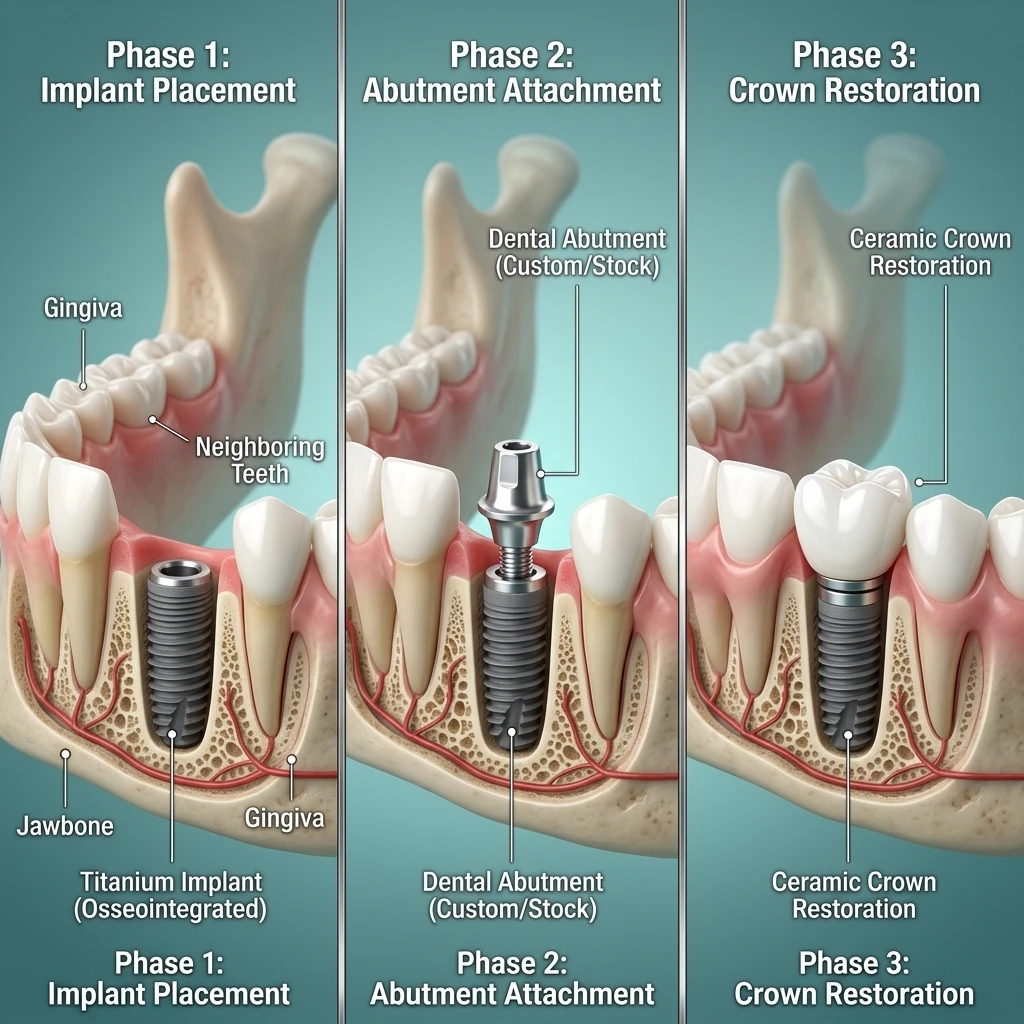
Endosteal implants are placed directly into the jawbone. They are the most common type used worldwide — the benchmark against which all others are compared. A small titanium screw (typically 3.5–5 mm in diameter and 8–16 mm in length) is inserted into the bone surgically. After osseointegration (3–4 months), an abutment and crown are attached.
Endosteal implants have the highest success rate (95%+), the best long-term data, and the most natural feel. They are suitable for the vast majority of patients who have adequate bone volume. Single-tooth implants, multi-tooth bridges, and All-on-4 full-arch restorations all use endosteal implants as their foundation.
Subperiosteal Implants (For Severe Bone Loss)
Subperiosteal implants sit on top of the jawbone beneath the gum tissue, rather than inside the bone. A custom metal framework is fabricated from a detailed scan of your jaw and placed under the gum, where it rests on the bone surface. Posts protrude through the gum to support the prosthetic teeth.
These are used when the jawbone has deteriorated so severely that there isn't enough volume for standard endosteal implants, and the patient is not a candidate for extensive bone grafting. They are far less common today than they once were — modern bone grafting and zygomatic implants have largely replaced them.
Zygomatic Implants (For Extreme Upper Jaw Bone Loss)
When the upper jawbone has severely resorbed (as often happens with long-term denture wear), standard implants and even bone grafts may not be feasible. Zygomatic implants are anchored in the cheekbone (zygoma) rather than the jawbone — a denser, more stable structure that doesn't resorb. They are longer (30–52.5 mm) and require specialist surgical expertise.
Zygomatic implants are a last resort but an effective one — they allow patients with severe upper jaw bone loss to receive a fixed implant restoration without years of bone grafting. This is highly specialised treatment available at referral centres.
Mini Implants
Mini implants are narrower in diameter (less than 3 mm) than standard implants. They were originally designed for narrow spaces between teeth but are now most commonly used to stabilise lower dentures in patients with insufficient bone for standard implants. Mini implant placement is less invasive, heals faster, and costs less — but they are not suitable for full crown or bridge restorations due to their reduced load-bearing capacity.
Types of Implant Restorations
Single Crown
One implant supports one crown — replacing a single missing tooth without involving adjacent teeth. The gold standard for single-tooth replacement. The crown is either screwed onto the abutment (screw-retained) or cemented.
Implant-Supported Bridge
Two or more implants support a bridge that replaces several consecutive missing teeth. For example, three missing teeth can be replaced by two implants at each end with a pontic (dummy tooth) in the middle. More efficient and less costly than placing one implant per missing tooth, while still avoiding the need to alter adjacent natural teeth.
All-on-4
Four implants support an entire arch of teeth — a full set of upper or lower teeth. Two implants are placed vertically in the front of the arch, and two are angled at 45 degrees toward the back. The angling maximises contact with available bone and typically eliminates the need for bone grafting even in patients with significant bone loss. A temporary set of teeth is often fitted on the day of surgery; the permanent prosthetic is attached 3–6 months later after osseointegration.
All-on-4 is life-changing for patients who have lost all their teeth or are facing full-mouth extractions. Compared to conventional full dentures, implant-supported arches are infinitely more stable, preserve jawbone, and feel natural. Compared to placing 8–10 individual implants, All-on-4 is significantly more affordable.
All-on-6
Similar to All-on-4 but with six implants for even greater stability and distribution of bite forces. Preferred for patients with good bone volume who place high demands on their teeth (active people, those with strong bite forces). The extra two implants provide redundancy — if one implant were to fail, the arch would still be supported.
The Implant Procedure: What Happens at Each Stage
3D CBCT Scan and Treatment Planning
A cone beam CT (CBCT) scan creates a 3D map of your bone anatomy, nerve location, and sinus position. Digital implant planning software determines the ideal implant position, angle, and length for your specific anatomy. This planning stage is critical for predictable outcomes.
Bone Grafting (if needed)
If bone volume is inadequate, grafting builds it up before implant placement. Materials include autogenous bone (from your own jaw or chin), synthetic grafts, or donor bone. Graft integration takes 3–6 months. Socket preservation (grafting immediately after extraction) minimises bone loss and reduces or eliminates the need for later grafting.
Implant Placement Surgery
Under local anaesthesia (and sedation if preferred), a small incision is made in the gum. A precise drilling sequence creates the implant site in the bone, and the titanium implant is threaded in. A healing cap or temporary crown may be placed. The procedure typically takes 30–60 minutes per implant.
Osseointegration Healing Period
Over 2–4 months, the bone fuses biologically with the titanium surface (osseointegration). During this period you wear a temporary prosthetic (if applicable) and maintain excellent oral hygiene. Smoking is strictly prohibited as it dramatically increases failure risk.
Abutment Placement
After osseointegration is confirmed (your dentist checks stability and may take an X-ray), the healing cap is removed and the abutment — the connector piece that will hold the crown — is attached to the implant.
Final Crown / Prosthetic Delivery
Impressions or a digital scan of the abutment is taken to fabricate your final crown or bridge. The restoration is matched precisely to the colour and shape of your adjacent teeth. Once cemented or screwed into place, your implant restoration is complete.
Implant Materials: Titanium vs Zirconia
Titanium implants are the established standard — over 60 years of clinical data, excellent osseointegration properties, and a success rate above 95%. The body tolerates titanium exceptionally well; true titanium allergies are extremely rare.
Zirconia implants are a newer alternative — metal-free, tooth-coloured, and appealing to patients with titanium sensitivity concerns or preferences for non-metal restorations. Clinical data is still accumulating for long-term outcomes, but early results are promising. They are typically more expensive than titanium.
For most patients, titanium remains the evidence-based first choice. Zirconia is a legitimate alternative for specific situations — your implant specialist can guide you based on your anatomy and preferences.