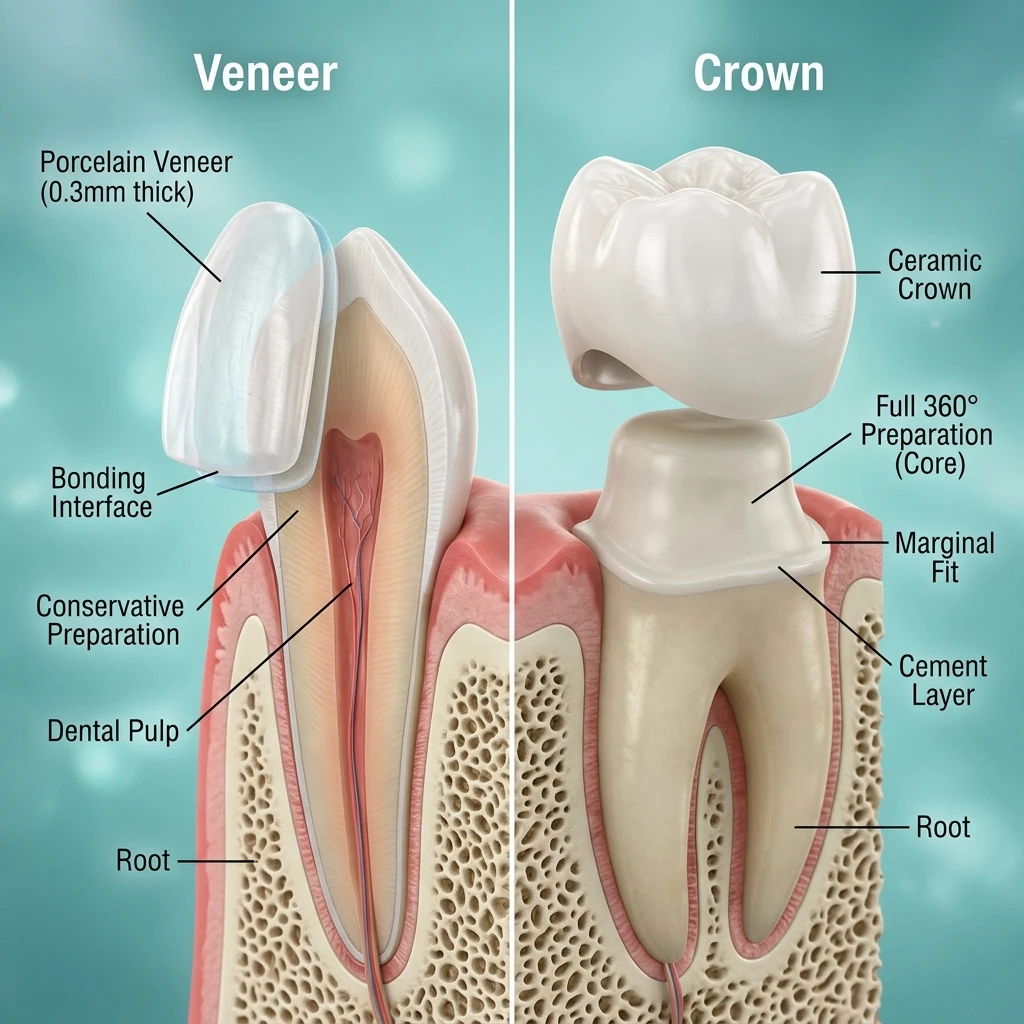
Introduction: Both Improve Your Smile, But They're Very Different
If you're considering a smile makeover, you've likely heard about both dental crowns and veneers. Both are popular cosmetic and restorative treatments that can dramatically improve your smile. But despite their similar goals, they work in completely different ways. Choosing between them matters because they require different amounts of tooth preparation, have different lifespans, handle different problems, and cost differently.
This guide will help you understand exactly what each is, when one is better than the other, and how to make the right choice for your situation.
What is a Dental Crown?
A crown is a complete cover for your tooth. Once placed, it becomes your tooth's new outer surface. Imagine a thimble that fits over your finger — a crown is similar, except it's made of tooth-colored ceramic, porcelain, or sometimes a combination of materials, and it fully encases the visible portion of your tooth.
How it works: Your dentist removes a significant layer of tooth structure from all sides — roughly 1.5 to 2 mm — to make room for the crown. This reduction occurs on the top, front, back, and sides of the tooth. The tooth is shaped into a smaller cone-like form. Then, a temporary crown protects it while a permanent crown is custom-made in a lab (usually over 1–2 weeks). Finally, the permanent crown is cemented onto the prepared tooth.
Materials: Crowns can be made of several materials, each with benefits:
- Porcelain or ceramic: Most lifelike and tooth-colored. Excellent for front teeth. Slightly more prone to chipping on back teeth than metal crowns. (Cost: Rs. 4,000–8,000 per tooth in India)
- Porcelain fused to metal (PFM): Strong and natural-looking. The metal base adds strength, making it ideal for molars. Slightly more visible at the gum line if gums recede. (Cost: Rs. 3,000–6,000)
- All-metal or gold crowns: Most durable but very visible. Usually reserved for back teeth or patients who specifically want gold. (Cost: Rs. 8,000–15,000)
- Zirconia: Very strong, tooth-colored, and durable. Newer option. (Cost: Rs. 6,000–10,000)
When you need a crown: Crowns solve big structural problems. They're used after root canal treatment to protect the now-fragile tooth. They cover large fillings that have weakened a tooth. They rebuild broken teeth, cover severely discolored teeth that won't whiten, protect dental implants, or fix teeth damaged by grinding or trauma. They're restorative first and cosmetic second.
What is a Veneer?
A veneer is a thin shell applied to the front surface of your tooth. Think of it like applying a sticker or decal to the front of your tooth — except it's permanently bonded ceramic or composite, and it transforms only the visible portion. Veneers leave the back and sides of your tooth untouched.
How it works: Your dentist removes a very thin layer of enamel from the front of your tooth (often just 0.5 mm — the thickness of a credit card). This is much less invasive than crown preparation. An impression is taken, and a custom veneer is fabricated in the lab (usually 1–2 weeks). Finally, the veneer is bonded to the front of your tooth with special dental cement, and any excess is trimmed.
Materials: Veneers are typically made of two types:
- Porcelain veneers: More durable and stain-resistant. They look incredibly natural and can last 10–15 years with proper care. Lab-made, so they're customized. (Cost: Rs. 3,000–6,000 per tooth)
- Composite veneers: Applied directly to your tooth by the dentist in one appointment — no lab work needed. Less expensive and can be repaired easily if they chip. But they stain more easily and last only 5–7 years. (Cost: Rs. 1,500–3,500 per tooth)
When you want veneers: Veneers are cosmetic-focused. They're perfect for fixing minor chips, gaps, slightly crooked teeth, tooth discoloration that won't whiten, or a tooth that's slightly too small. They shine when your tooth structure is essentially healthy but its appearance needs improvement.
Key Differences: Coverage, Tooth Preparation, Strength, and Purpose
Coverage: Crowns cover the entire tooth (all surfaces). Veneers cover only the front and, to some extent, the sides — the back of the tooth remains unchanged.
Tooth preparation: Crowns require significant preparation — removing roughly 50 percent of the tooth's natural structure. Veneers require minimal preparation — only the front surface, and very little at that (often just the enamel).
Reversibility: Crowns are essentially irreversible. Once the tooth is prepared, you'll always need a crown (or repeated crowning). Veneers are somewhat more reversible — the underlying tooth still has most of its structure, so theoretically, you could remove a veneer and the tooth could exist without one, though it would look odd. However, practically, once prepared for a veneer, you typically want a veneer on it forever.
Strength: Crowns are far stronger. They protect and reinforce a compromised tooth. Veneers don't strengthen the underlying tooth — they improve its appearance.
Purpose: Crowns are restorative — they fix structural damage. Veneers are cosmetic — they improve appearance on otherwise healthy teeth.
| Feature | Crowns | Veneers |
|---|---|---|
| Coverage | Entire tooth (360°) | Front surface only |
| Tooth removal | 1.5–2 mm on all sides | 0.5 mm on front only |
| Reversibility | Not reversible | Somewhat reversible |
| Durability | 10–15 years (porcelain) | 10–15 years (porcelain); 5–7 years (composite) |
| Cost per tooth | Rs. 3,000–15,000 | Rs. 1,500–6,000 |
| Time to placement | 1–2 weeks (temp + perm appointment) | 1–2 weeks (lab) or 1 day (composite) |
| Primary purpose | Restoration + cosmetics | Cosmetics |
| Best for | Damaged, weakened, root canal teeth | Healthy teeth needing cosmetic improvement |
When a Crown Is the Better Choice
After root canal treatment: Root canal-treated teeth become brittle and are at higher risk of fracture. A crown provides essential protection and typically lasts as long as the root canal does.
Severely damaged teeth: A tooth broken roughly in half, or one with a large chunk missing, needs structural reinforcement that only a crown provides.
Large, failing fillings: If a filling covers half your tooth's surface, the remaining tooth structure is weak. A crown is safer than repeatedly replacing large fillings.
Tooth grinding or heavy bite: Patients who grind their teeth (bruxism) need the strength of a crown to withstand the forces. A veneer on a grinding tooth would likely chip.
Severely discolored teeth that won't whiten: If whitening doesn't work, and the tooth needs protection anyway (like after a root canal), a crown is practical. If whitening alone could work on a healthy tooth, veneers might be better.
Worn-down teeth: Teeth worn from years of grinding, acid reflux, or acidic drinks often need rebuilding — a crown's job.
When Veneers Are the Better Choice
Cosmetic concerns on healthy teeth: A tooth is structurally sound but has a gap, slight chip, or slight discoloration. Veneers solve this without over-treating the tooth.
Whitening-resistant discoloration: Teeth discolored from tetracycline medication or intrinsic staining don't respond to whitening. Veneers mask this beautifully without removing excess tooth structure.
Minor chips or irregularities: Veneers smooth minor chips, slight cracks, or slightly too-small teeth without the invasiveness of a crown.
Closing small gaps: A small gap between front teeth can be closed with veneers on both teeth. It's less invasive than crowning or orthodontics.
Smile makeovers on healthy teeth: Patients with generally healthy teeth who want a cosmetic upgrade often benefit from veneers on a few front teeth rather than crowns.
Can You Have Both? (Yes, Different Teeth)
It's perfectly possible and actually common to have both crowns and veneers — just on different teeth. For example, you might have a crown on tooth #9 (because it had root canal treatment) and veneers on teeth #8 and #10 (for cosmetic appearance). Your dentist will match colors across all three so they look like a cohesive smile.
Longevity and Care Comparison
Crowns longevity: Porcelain and zirconia crowns last 10–15 years on average, sometimes longer. Metal crowns last even longer (15–20+ years). They can fail if the underlying tooth develops decay (usually at the margin where the crown meets the tooth), if the cement fails, or if they're damaged by trauma or grinding.
Veneer longevity: Porcelain veneers last 10–15 years. Composite veneers last 5–7 years. They can chip, stain (composite more easily), or fail if the bonding fails.
Care for crowns: Brush and floss normally. Avoid chewing extremely hard objects (ice, hard candy, bones) as they can crack the crown. If you grind your teeth, wear a night guard. Crowns need no special maintenance, but the underlying tooth still needs protection from decay.
Care for veneers: Brush gently with a soft toothbrush. Floss carefully around the edges. Avoid very hard or sticky foods that could pull at or crack the veneer. Composite veneers should be polished occasionally to maintain shine. Porcelain veneers are more stain-resistant but can still be discolored by smoking or dark beverages over time.
Cost Comparison in Gudivada
Crowns: In Gudivada, a single crown typically costs Rs. 3,000–15,000 depending on material. Porcelain/zirconia crowns are Rs. 6,000–10,000. A full smile makeover with 4–6 crowns runs Rs. 24,000–90,000.
Veneers: Porcelain veneers in Gudivada are typically Rs. 3,000–6,000 per tooth. Composite veneers are Rs. 1,500–3,500 per tooth. A 6-tooth smile makeover with porcelain veneers runs Rs. 18,000–36,000.
Upfront cost vs. long-term value: Veneers are initially cheaper, but if you need work on 4–6 teeth, the gap narrows. Both crowns and quality veneers are investments that improve your smile for over a decade. Considering the 10–15 year lifespan, the yearly cost is modest.
How to Decide: Questions to Ask Your Dentist
Ask yourself and your dentist:
- Is the tooth structurally weak or does it need protection? (If yes, lean toward crown.)
- Is the tooth healthy but the appearance needs fixing? (If yes, lean toward veneer.)
- Has this tooth had root canal treatment? (If yes, crown is often recommended.)
- Do I grind my teeth or have a heavy bite? (If yes, crown is more durable.)
- What is the primary concern — the tooth's strength or its appearance? (Strength = crown; appearance = veneer.)
- How much of the tooth needs to be covered? (All surfaces = crown; mostly front = veneer.)
Your dentist's examination is crucial. During the consultation, they'll assess the tooth structure, check for decay or weakness, evaluate your bite, and recommend the option that addresses your specific situation. Sometimes what seems like a veneer case turns out to need a crown once the tooth is examined more closely.